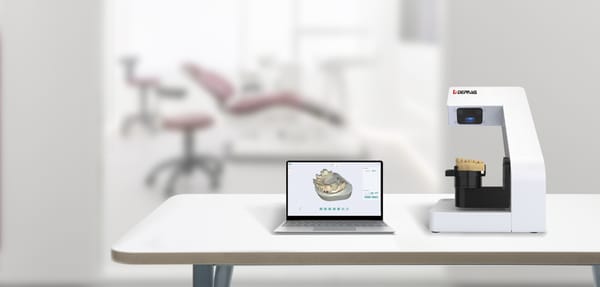
3D Dental Scanner 3F
Zhejiang Zahndent Biotechnology Co., Ltd · source
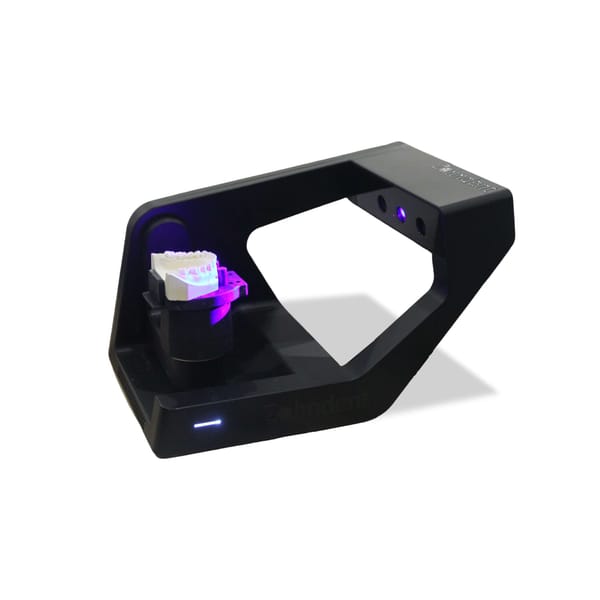
3D Dental Scanner 3F
Fast
We have high quality hardwar& and optimized software that can scan a complete single crown in seven seconds.
Super Accurate
Ten second micron accuracy(Use IS012836 standard test)
Open system
Enjoy the freedom of our open system,which allows you to import and export files in STL format, so you can design on almost any software.
Texture
Texture scanning enables technicians to understand doctors' intentions and design better products.
About Dental Scanner
What is a Dental Scanner?
A dental 3D scanner is a device that derives 3D information from 2D images of three-dimensional shapes such as teeth and tissues inside a patient's oral cavity, which is then used to obtain the same color information of real-world objects. In dentistry, the shape of the patient's teeth and oral tissue that is acquired as a three-dimensional image from this device is used in dental treatment processes such as establishing treatment plans and making dental prosthetics.
Dental scanners were first introduced by CEREC. This was followed by the development of CEREC 2 and CEREC 3, and today, CEREC has become one of the most used systems. Since the introduction of CEREC, many manufacturers have developed various types of IOS/EOS, leading the digitalization of the dental industry. Zahndent's 3D dental scanners are all compatible with CEREC system.
Types of Dental Scanners
There are indirect and direct methods for digitizing impression taking.
The indirect method is the conventional way of creating a model by injecting dental plaster into the impression obtained from the patient's oral cavity and scanning the model with an extraoral scanner, or directly scanning the impression without a model. Main products of extraoral scanners include 3Shape's E-series, Dentsply Sirona's in Eos series, Medit's T-series, and Zirkonzahn's S-series. Zahndent's blue light scanner is thi type of scanner.
The direct method is scanning the patient's oral cavity directly using intraoral scanner (IOS) while creating a three-dimensional image at the same time.
Main products of intraoral scanners include 3Shape's TRIOS, Dentsply Sirona's Primescan, MDEIT's i-series, Carestream Dental's CS-series, and Align Technology i-Tero.Zahndent is launching a new product ZD-P3.
Currently, intraoral scanners are mainly used in dental clinics, and extraoral scanners are mainly used in dental laboratories. An extraoral scanner has better stability and precision than an intraoral scanner, but it takes longer time to scan and prepare plaster models. On the other hand, intraoral scanners have a simpler procedure of scanning and is less time-consuming because it directly captures the patient's oral cavity in the clinic.
How a 3D Scanner Works
Extraoral Scanner can be classified into contact and contactless scanners.
Contactless scanners obtain data on surface shape by measuring the distance of an object using triangulation when the light source emitted from the scanner's light source is reflected from the surface of an object and reaches the light receiver. This method is used in most EOSs because of its fast scan speed and high stability.
Contact scanners measure the distance of an object by putting the probe in direct contact with an object. Although this has higher accuracy than contactless scanners, it can cause deformation or damage after directly contacting an object and has slower scan speed.
Zahndent blue light 3D scanner is contactless scanner, which make the fast scan speed and high stability.
Product Information
| Manufacturer | Zhejiang Zahndent Biotechnology Co., Ltd |
|---|